QEMU LAUNCH CONTROL // WINDOWS 10 & 11

A native Windows launcher for QEMU, styled after the NORAD screens of WarGames. Mac OS X Tiger runs with Quartz Extreme and Core Image on your graphics card, every VM docks into one window, and install media arrive over HTTPS and BitTorrent at once.

QUARTZ EXTREME + CORE IMAGE // PORTABLE // QEMU 11.1.2 INSIDE // X86-64, POWERPC AND 68K GUESTS

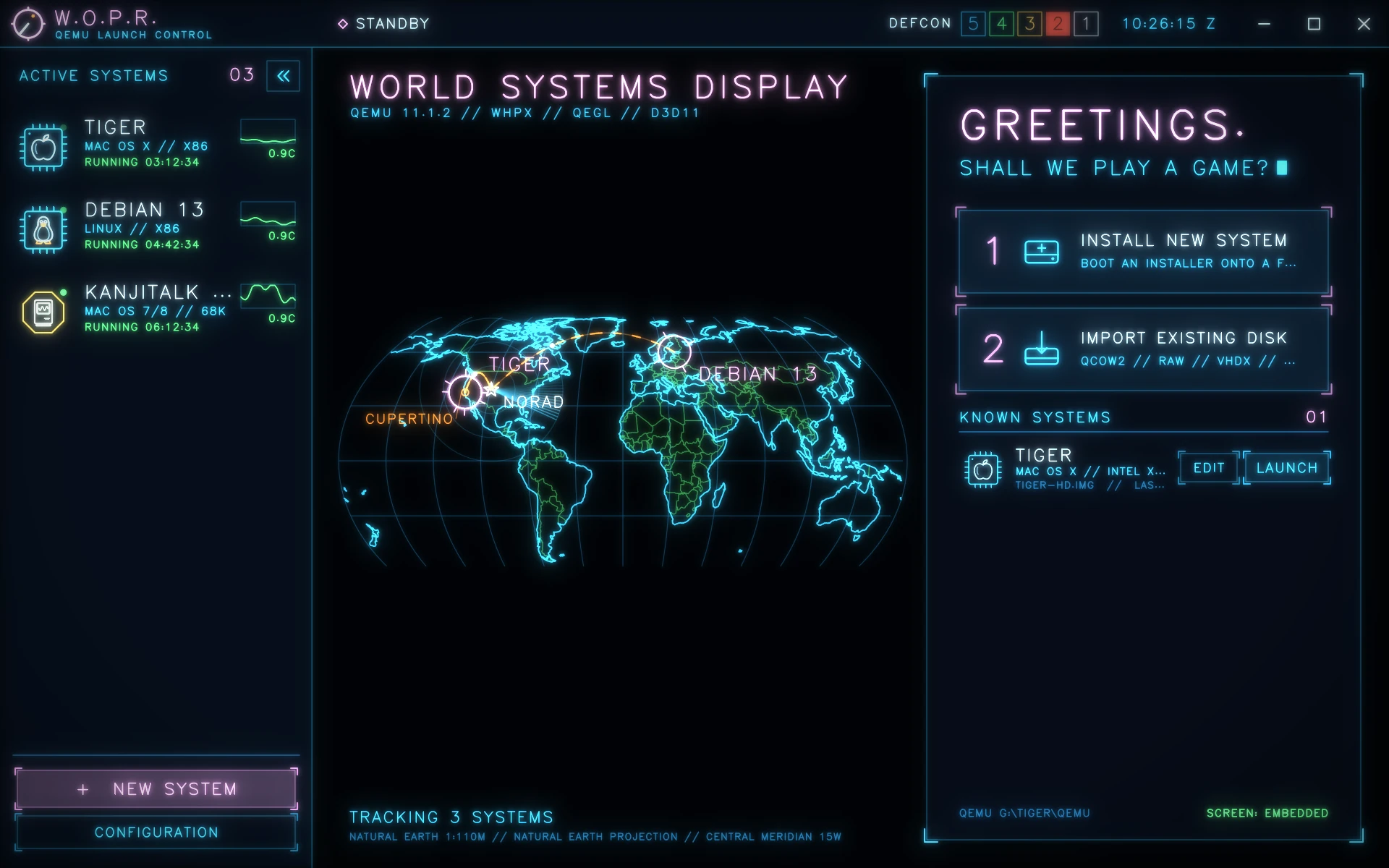
The W.O.P.R. welcome screen: a vector world map with tracks to two running systems, and the list of known systems

THE WORLD SYSTEMS DISPLAY // RUNNING SYSTEMS ON THE LEFT, EACH A TRACK FROM NORAD TO ITS HOME SITE

SECTION 01

31 SECONDS: SYSTEM PROFILER IN A TIGER VM, THEN TIGERVIZ, OUR OPENGL AND CORE IMAGE DEMO. SCREENS FROM QEMU, COMPOSITED BY W.O.P.R.'S OWN RENDERER.

Mac OS X 10.4 Tiger runs in W.O.P.R. with its window compositor and Core Image on the host's graphics card. System Profiler says it plainly: Quartz Extreme: Supported and Core Image: Hardware Accelerated, at 240 Hz.

Underneath is qegl, a paravirtual OpenGL device written for this QEMU, and guest drivers written for Tiger: the display driver (VBL, hardware cursor), the graphics accelerator Quartz Extreme talks to, and the OpenGL driver. Tiger's GL commands stream to the host and run on its GPU through Mesa's Zink on Vulkan, with our fixes to Mesa. Finished frames reach W.O.P.R.'s Direct3D 11 display as shared textures, never copied back through guest memory.

Applications get the GPU too: Core Image filters, OpenGL at up to 220 fps in TigerViz, and the GL 3 and 4 entry points behind WebGL 2 in Camino.
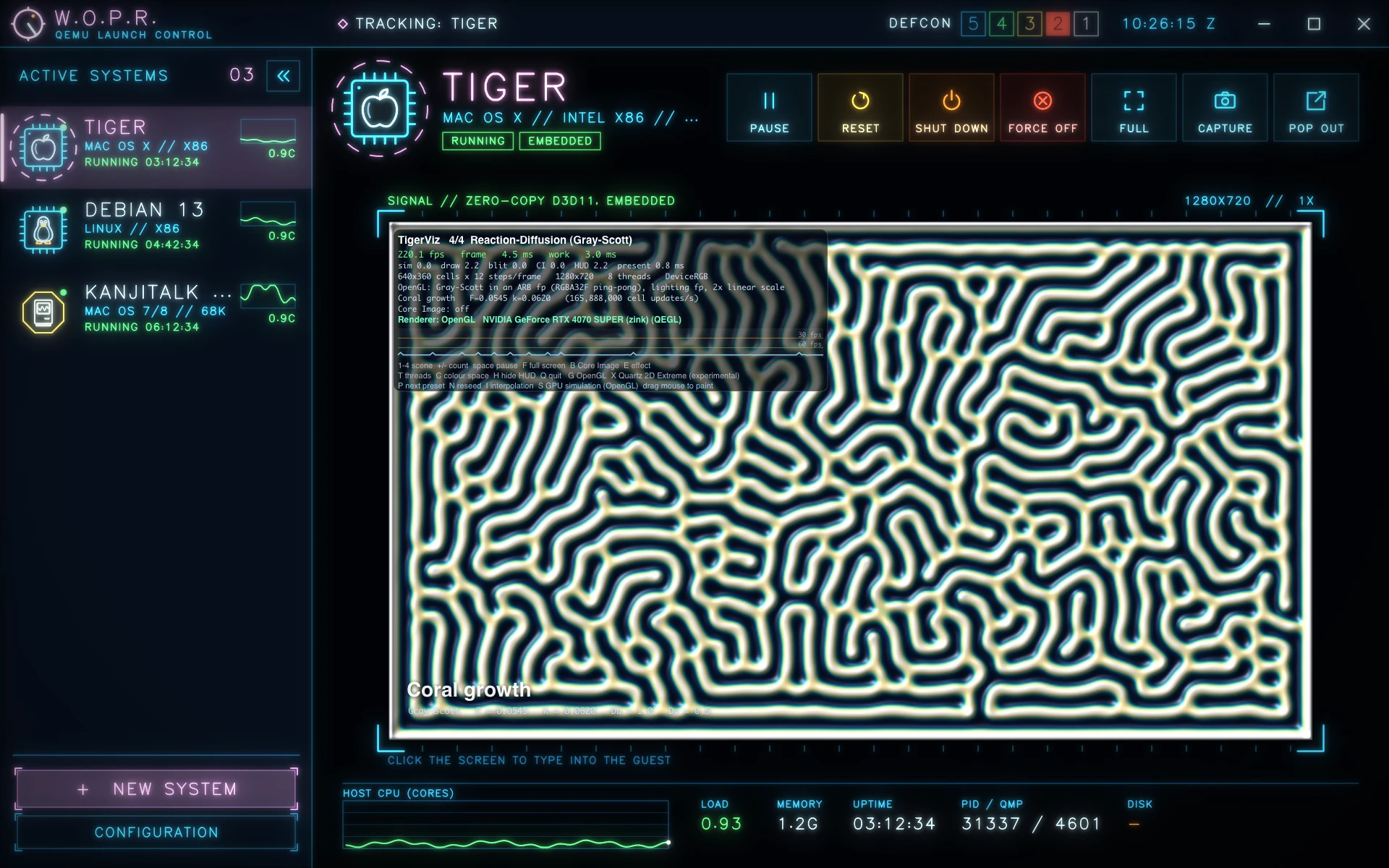
Mac OS X 10.4 Tiger docked in W.O.P.R., running TigerViz at 220 fps with OpenGL on an NVIDIA GeForce RTX 4070 SUPER through Zink and qegl

TUNED BY AUTORESEARCH

Much of that speed was found by an autonomous research loop in the style of karpathy's autoresearch. An agent proposes one change; a harness boots a scratch Tiger and measures it against the current best in the same VM, in both orders (ABBA, then BAAB). A change is kept only if it wins and passes every gate: bit-identical GPU images, a WebGL 2 conformance subset, stability soaks and a 1:1 cursor. Six sessions so far:

SESSIONKEPTMEASURED
1Quad splitting, a ring barrier fix, polygon stipple on ZinkGL checks on Zink 7/12 → 11/12; stability anomalies 4 → 0
2Logging off the render thread; smooth pointsperf metric +13 %; Core Image blur 21–25 → 54–58 fps; GL checks 12/12
38 MB command rings for applicationstexture uploads +28–36 %; GL 3 entry-point test 2,800 → 3,460 frames/s
4A Mesa patch: no GPU wait when switching Zink contexts+6–8 %; context switches 224 → 48 ms per second; TigerViz with CIBloom +13–32 %
5Early readback of application GL windowsTigerViz OpenGL at 240 Hz: 120 → 193–220 fps
6Triple-buffered, coalesced WindowServer updatesfull-screen frames on screen 121 → 237; TigerViz 236–240 fps

THE GUEST DRIVERS, MIT LICENSED

tiger-qegl-20261022.tar.xz 571 KB

QemuGLAccel, QemuGA, QemuGLDriver and QemuVGA, the display tools, TigerViz, our seven Mesa patches and the OpenCore boot tools. Build the drivers inside Tiger with Xcode 2.5: sudo sh install.sh. The host side, QEMU with qegl and the patched Mesa, is in the portable zip. Or hand AGENTS.md to your coding agent: it goes from an empty folder to Quartz Extreme: Supported, with a check at every step.

SHA-256 82597350c6f5e8bfe4ae6d0aa04d3934794f3f20b1a87f6e67b16b96dc0b2605
Mac OS X isn't included: bring your own copy, Xcode 2.5, and the SMC key of a Mac you own.

SECTION 02

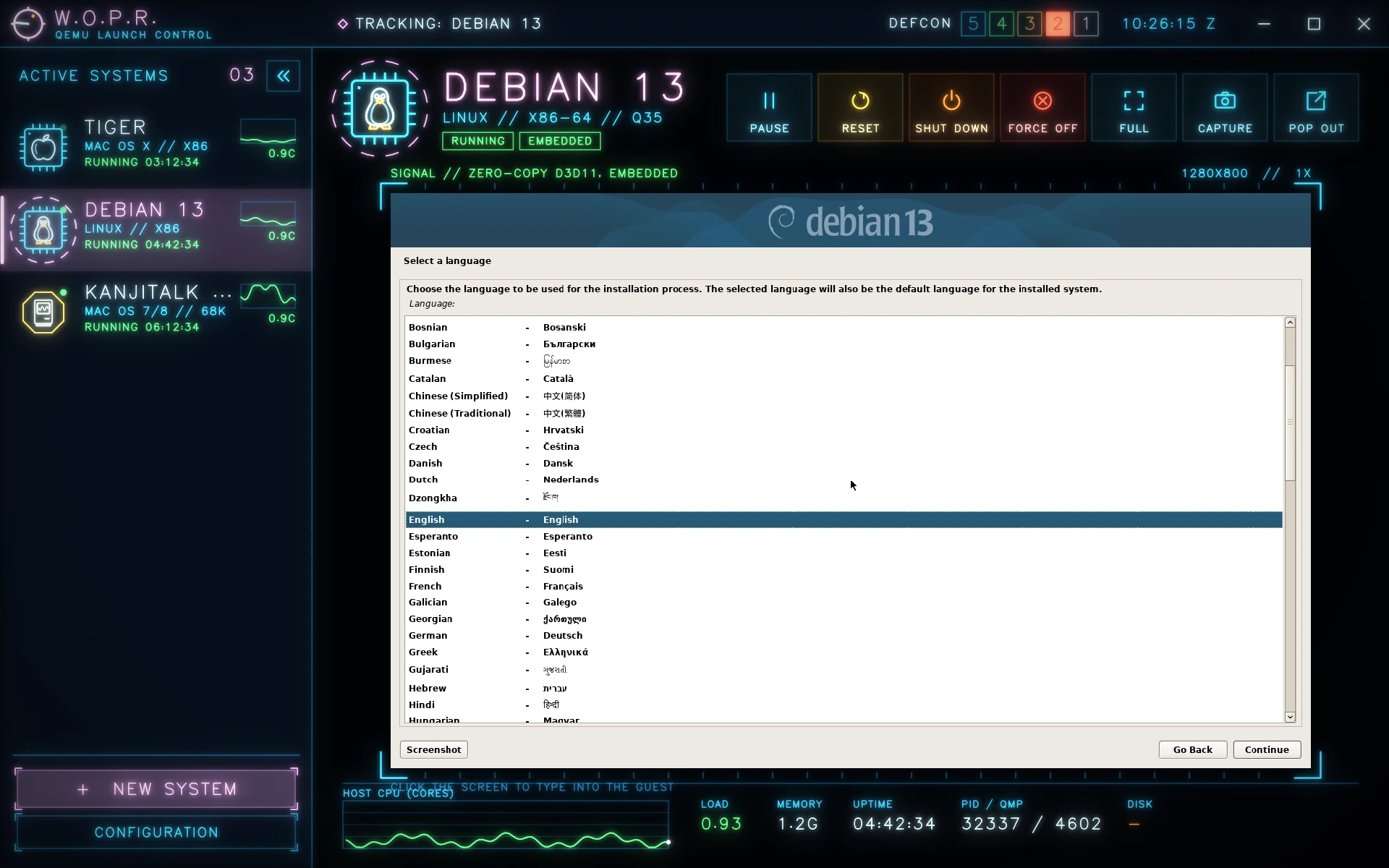
W.O.P.R. ships a QEMU whose Direct3D 11 display can live inside another program. Each VM's screen is QEMU's own window, docked into the launcher and scaled by whole pixels: keys and mouse go straight to the guest, and nothing is copied on the way.

POP OUT gives a VM a window of its own, DOCK brings it back. Quit W.O.P.R. and the VMs keep running; the next W.O.P.R. docks them again.

Pause, reset, ACPI shutdown, force off and screenshots go through QMP. Inside a guest, Ctrl+Alt+G grabs the mouse and Ctrl+Alt+F goes full screen.

A Debian 13 installer docked inside W.O.P.R., with pause, reset, shut down, force off, full screen, capture and pop out

SECTION 03

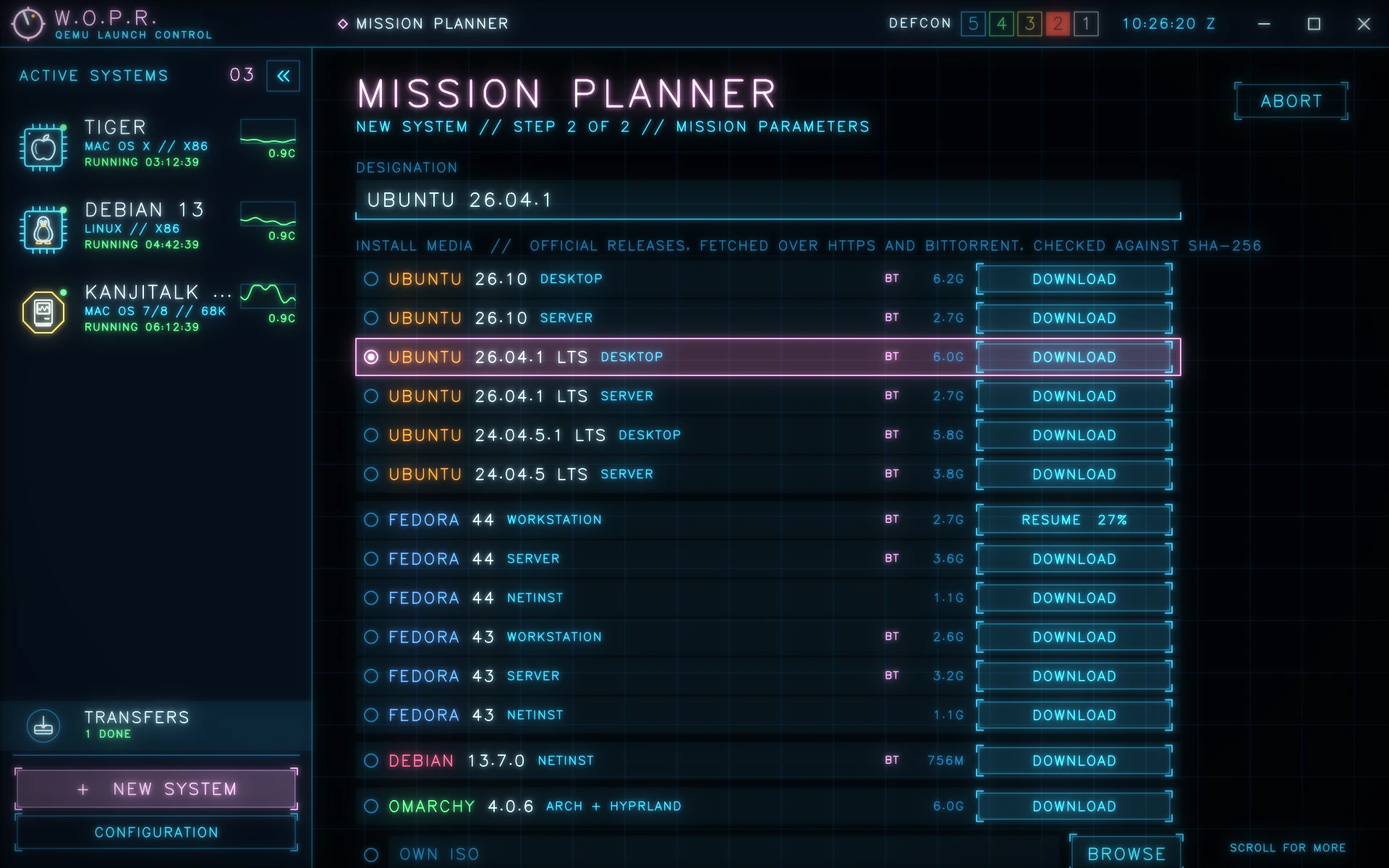
Pick Linux and the Mission Planner lists current releases, read live from releases.ubuntu.com, Fedora's signed CHECKSUM files, cdimage.debian.org and omarchy.org. Every entry carries its official SHA-256.

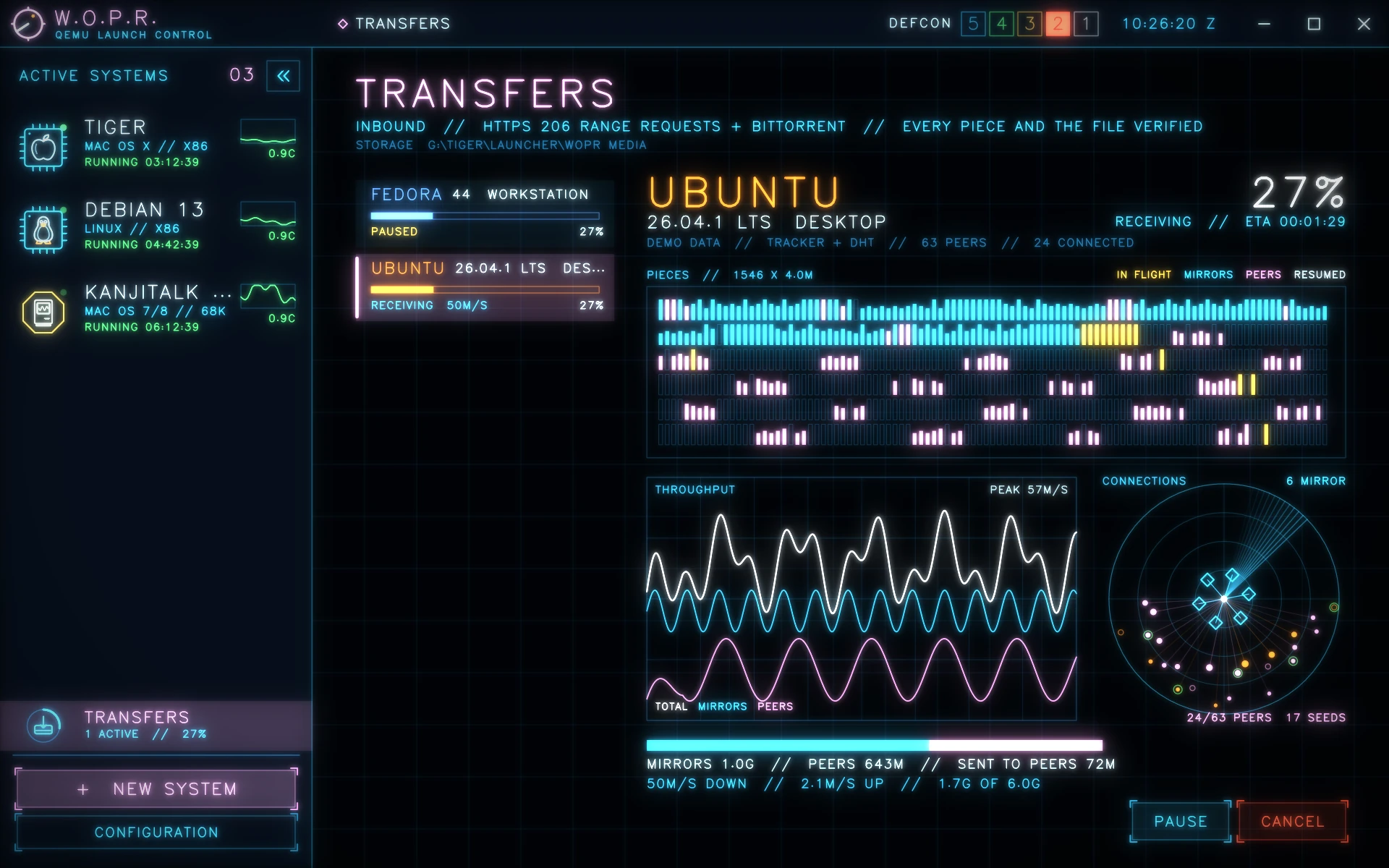
The download engine is W.O.P.R.'s own. HTTPS range requests to the official mirrors and BitTorrent (trackers, DHT, peer exchange, web seeds) feed one piece picker: mirrors take long runs from the front, peers take the rarest pieces. Every torrent piece is SHA-1 checked, and the whole ISO is SHA-256 checked before it gets its name. Downloads resume.

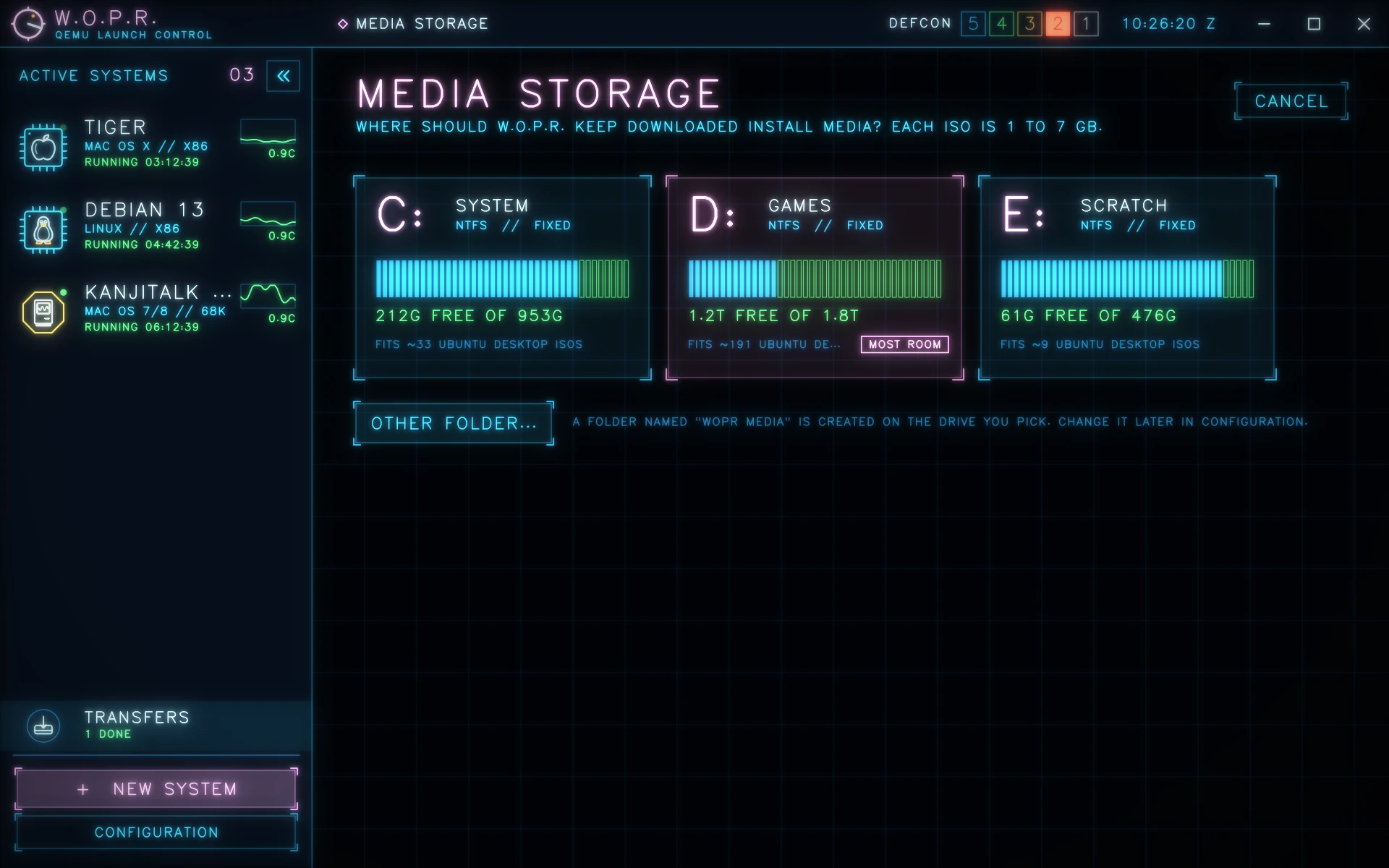
The first download asks which drive gets the ISOs. LAUNCH WHEN READY creates the system at once and boots it as soon as its ISO is verified.

The Mission Planner listing current Ubuntu, Fedora, Debian and Omarchy releases
The transfers view: a piece field coloured by source, a throughput scope and a radar of peers
The first-download storage chooser with three drives
47 SECONDS, REAL TIME: DEBIAN 13 NETINST FROM MIRRORS AND PEERS, VERIFIED, READY TO LAUNCH. RENDERED BY W.O.P.R.'S OWN RECORDER, NOT A SCREEN CAPTURE.

SECTION 04

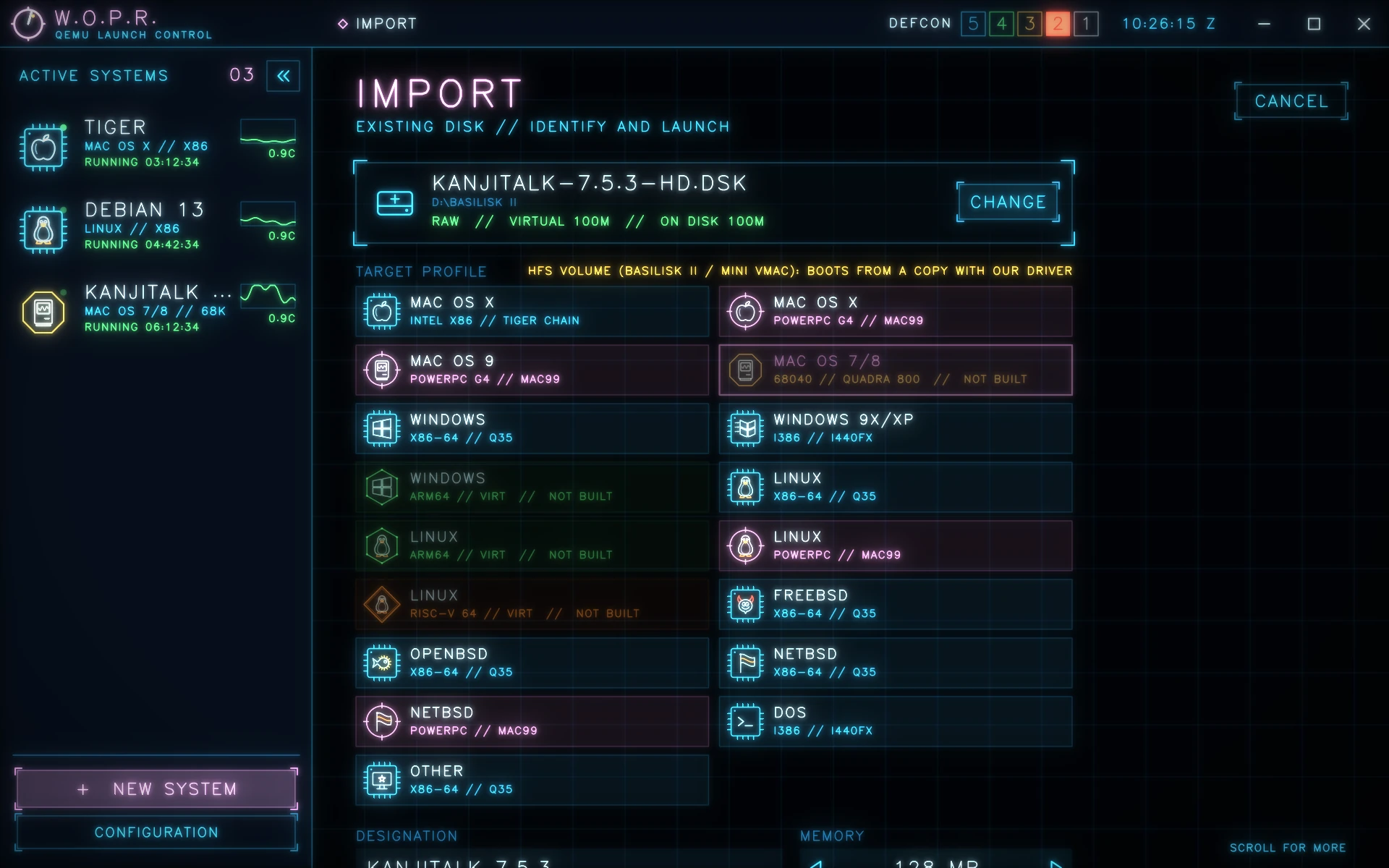
QEMU's Quadra 800 runs System 7 through Mac OS 8.1. Like the real machine, its ROM only boots SCSI disks that carry an Apple partition map and a driver, and the disks of Basilisk II and Mini vMac have neither.

So W.O.P.R. carries its own: a 1.4 KB SCSI driver in 68K assembly. The ROM loads it from the disk; it finds the HFS partition, adds the drive and serves every block through the SCSI Manager. Import a Basilisk II disk and W.O.P.R. boots a copy wrapped in a partition map with the driver. The original is left alone.

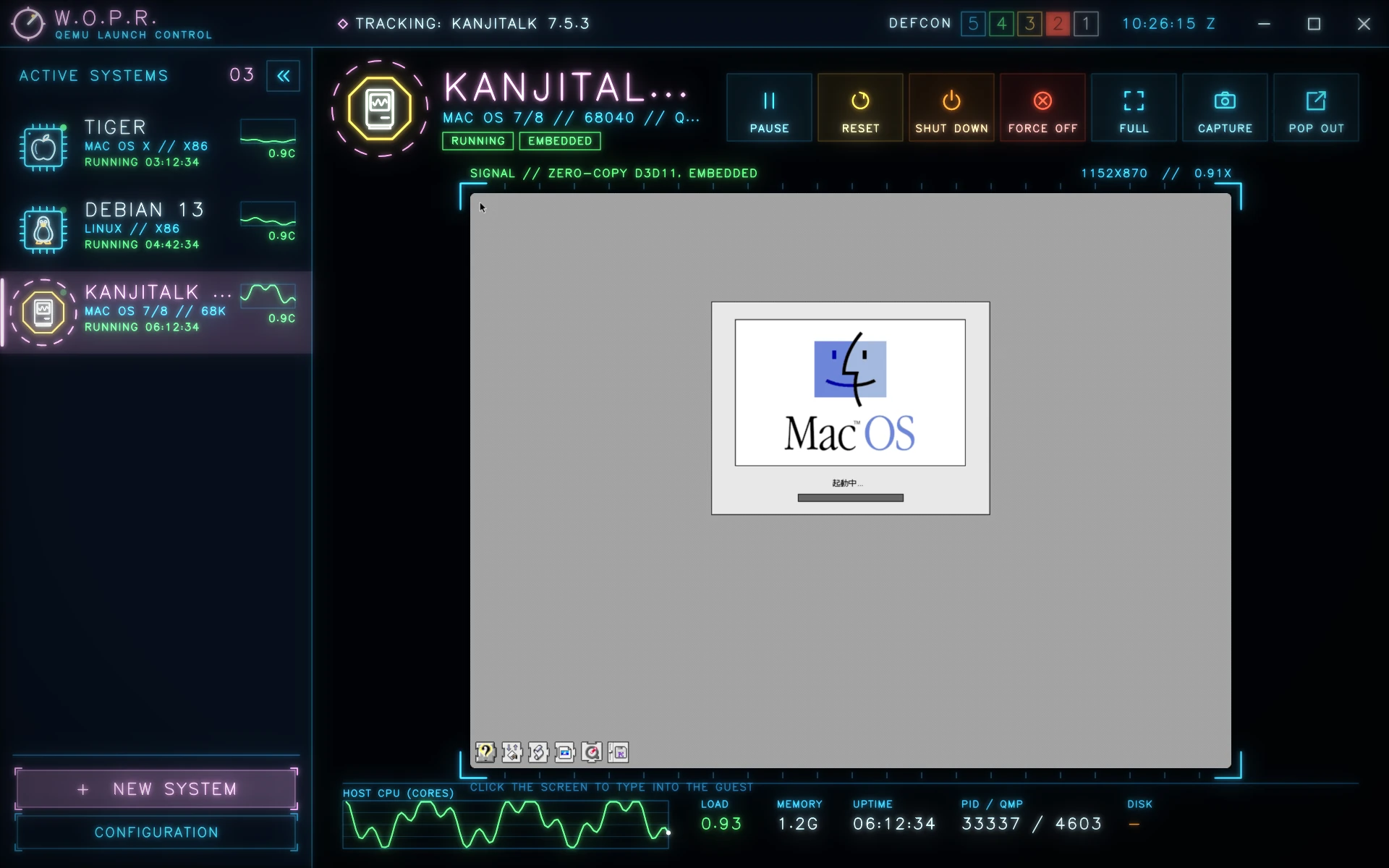
KanjiTalk 7.5.3 reaches the Finder in about fifteen seconds. Bring the ROM of a Quadra 610, 650 or 800; W.O.P.R. can't include Apple's.

FOUND THE HARD WAY // THE ROM VERIFIES THE CHECKSUM OF ANY DRIVER PARTITION NAMED "MACINTOSH", AS IF IT WERE APPLE'S. OURS GOES BY ANOTHER NAME.

KanjiTalk 7.5.3 starting up on QEMU's Quadra 800, docked inside W.O.P.R.
Importing a Basilisk II disk: W.O.P.R. recognises the HFS volume and picks the Mac OS 7/8 profile

SECTION 05

Frame for the CPU, glyph for the system. Chip for x86, reticle for PowerPC, hexagon for ARM, diamond for RISC-V, octagon for 68K, a dashed ring for the rest.

X86CHIPPPCRETICLEARMHEXAGONRISC-VDIAMOND68KOCTAGONOTHERDASHED RING
MAC OS XMac Os X on X86Mac Os X on PPCMac Os X on ARMMac Os X on RISC-VMac Os X on 68KMac Os X on OTHER
MAC OS 9Mac Os 9 on X86Mac Os 9 on PPCMac Os 9 on ARMMac Os 9 on RISC-VMac Os 9 on 68KMac Os 9 on OTHER
WINDOWSWindows on X86Windows on PPCWindows on ARMWindows on RISC-VWindows on 68KWindows on OTHER
WIN 9XWin 9X on X86Win 9X on PPCWin 9X on ARMWin 9X on RISC-VWin 9X on 68KWin 9X on OTHER
LINUXLinux on X86Linux on PPCLinux on ARMLinux on RISC-VLinux on 68KLinux on OTHER
FREEBSDFreebsd on X86Freebsd on PPCFreebsd on ARMFreebsd on RISC-VFreebsd on 68KFreebsd on OTHER
OPENBSDOpenbsd on X86Openbsd on PPCOpenbsd on ARMOpenbsd on RISC-VOpenbsd on 68KOpenbsd on OTHER
NETBSDNetbsd on X86Netbsd on PPCNetbsd on ARMNetbsd on RISC-VNetbsd on 68KNetbsd on OTHER
BSDBsd on X86Bsd on PPCBsd on ARMBsd on RISC-VBsd on 68KBsd on OTHER
DOSDos on X86Dos on PPCDos on ARMDos on RISC-VDos on 68KDos on OTHER
OTHEROther on X86Other on PPCOther on ARMOther on RISC-VOther on 68KOther on OTHER

SECTION 06

MAC OS X // INTEL

Mac OS X 10.4 Tiger through OpenCore, with qegl for Quartz Extreme and Core Image. Your own copy of Mac OS X, plus the MIT-licensed guest drivers and boot tools from section 1.

X86-64 // WHPX

Windows 7 to 11, Linux, FreeBSD, OpenBSD, NetBSD and anything else. Q35, virtio or AHCI, e1000, HD audio.

I386 // WHPX

Windows 95 to XP and DOS. i440FX, IDE, RTL8139.

POWERPC // MAC99

Mac OS X 10.1 to 10.5, Mac OS 9, Linux and NetBSD on OpenBIOS, with sungem and USB.

68040 // QUADRA 800

System 7 to Mac OS 8.1 at 1152x870, PRAM kept per system, SONIC Ethernet, Apple Sound Chip. Your ROM.

ARM64 // RISC-V

Profiles are ready; their QEMU targets come next.

Without Windows Hypervisor Platform, x86 guests still run, in TCG and slowly; W.O.P.R. says how to turn it on.

SECTION 07

PORTABLE BUILD

WOPR-portable-20261021-2.zip

32.7 MB // UNPACKS TO ABOUT 114 MB

SHA-25603c426d44553bd86458beba1f4609e019d780ec2c7c4896e8f2ec1a7a96ecb62

DOWNLOAD
  1. Unzip it anywhere you can write to: Downloads, a second drive, a USB stick. Not Program Files.
  2. Run WOPR.exe. It isn't signed yet, so Windows may warn about an unknown publisher: More info, then Run anyway.
  3. For fast x86 guests, turn on Windows Hypervisor Platform in Turn Windows features on or off and restart.

Settings, logs and your systems stay in that folder, so the whole thing can move. Downloaded ISOs go to the drive you pick.

For Tiger it also carries the host side of section 1: QEMU's qegl device and, in qemu\mesa, the Mesa build with our patches that its Zink backend loads.

NEEDS // WINDOWS 10 OR 11, 64-BIT // A DIRECT3D 11 GPU // A CPU FROM 2009 OR LATER (X86-64-V2)

SOURCE AND LICENSES

QEMU 11.1.2 with our changes (a Direct3D 11 display that embeds, a GL pass-through device, WHPX and input fixes) is GPL-2.0: the full source (34.1 MB, SHA-256 in qemu-11.1.2-wopr-source.tar.xz.sha256) and the changes as one patch (691 KB). Built in MSYS2 UCRT64 with ../configure \ --target-list=m68k-softmmu,ppc-softmmu,x86_64-softmmu \ --extra-cflags='-march=x86-64-v2 -mtune=generic -O2' \ --disable-werror \ --disable-docs \ --disable-debug-info \ --disable-tcg-interpreter \ --enable-sdl \ --disable-gtk \ --enable-slirp \ --enable-whpx \ --enable-zstd Mesa in the zip's qemu\mesa is Mesa 26.2.4 (MIT) with our patches 0001–0007; the zip's source folder has the patches and the build line, its licenses folder Mesa's licenses. The Tiger guest drivers, TigerViz, the Mesa patches and the boot tools are MIT licensed: tiger-qegl-20261022.tar.xz (571 KB). The libraries in the zip's qemu folder come from MSYS2; its licenses folder lists each package with its version. W.O.P.R.'s own source isn't published yet.